A week of multiplication lessons your kids will ask to repeat, from one game
New to teaching with MULTI? Start here. You don't need another curriculum. You need one thing on the shelf that works for a 7-year-old and a 12-year-old at the same table, takes zero prep, and leaves your kids arguing about factors on their own time.
That's the job MULTI was built for.
What IS MULTI?
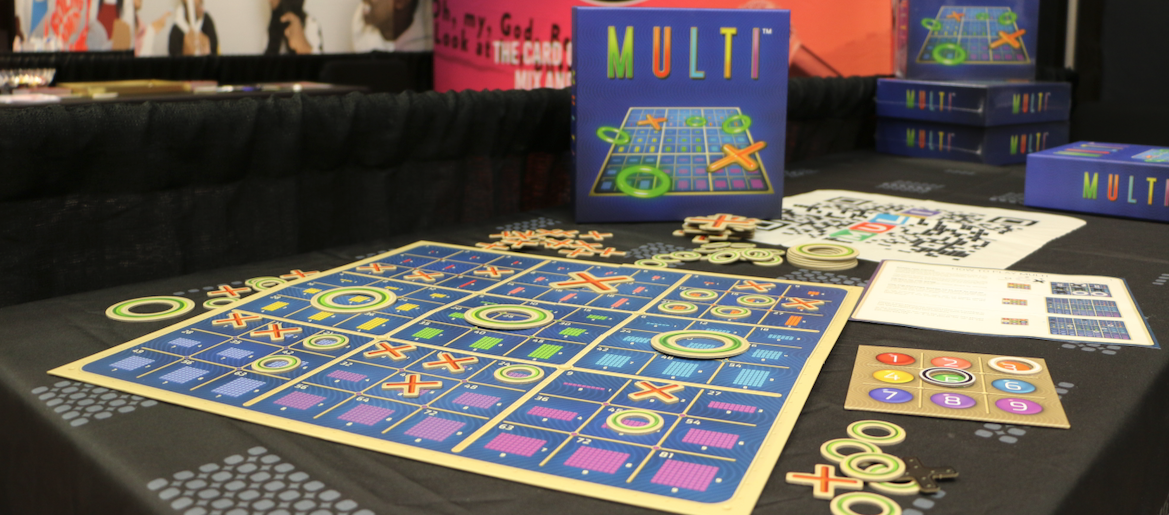
MULTI is tic-tac-toe played on a multiplication table… a reimagined multiplication table.
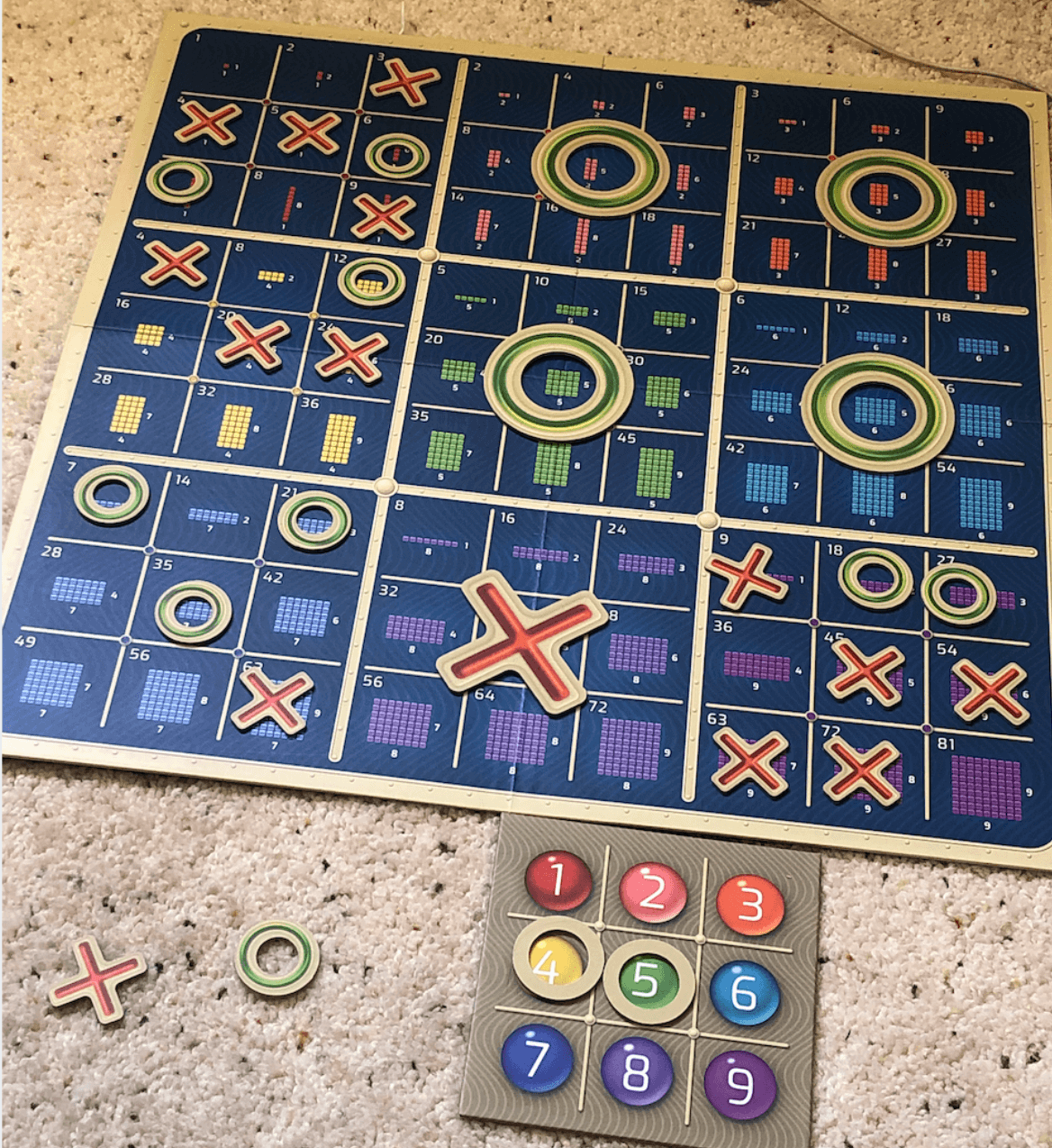
On your turn you slide one of the two tokens on the factor board, multiply the two factors, and claim that product everywhere it appears on the big board: nine mini tic-tac-toe boards holding every product from 1×1 to 9×9. Some products sit in only one spot. Others sit in four, and you claim all four in a single move. Get three in a row and it's yours.
If you already know Ultimate Tic-Tac-Toe, MULTI is the same nested idea with one change. Your legal moves are governed by common factors instead of by where your opponent just played.
Games run 10 to 20 minutes.
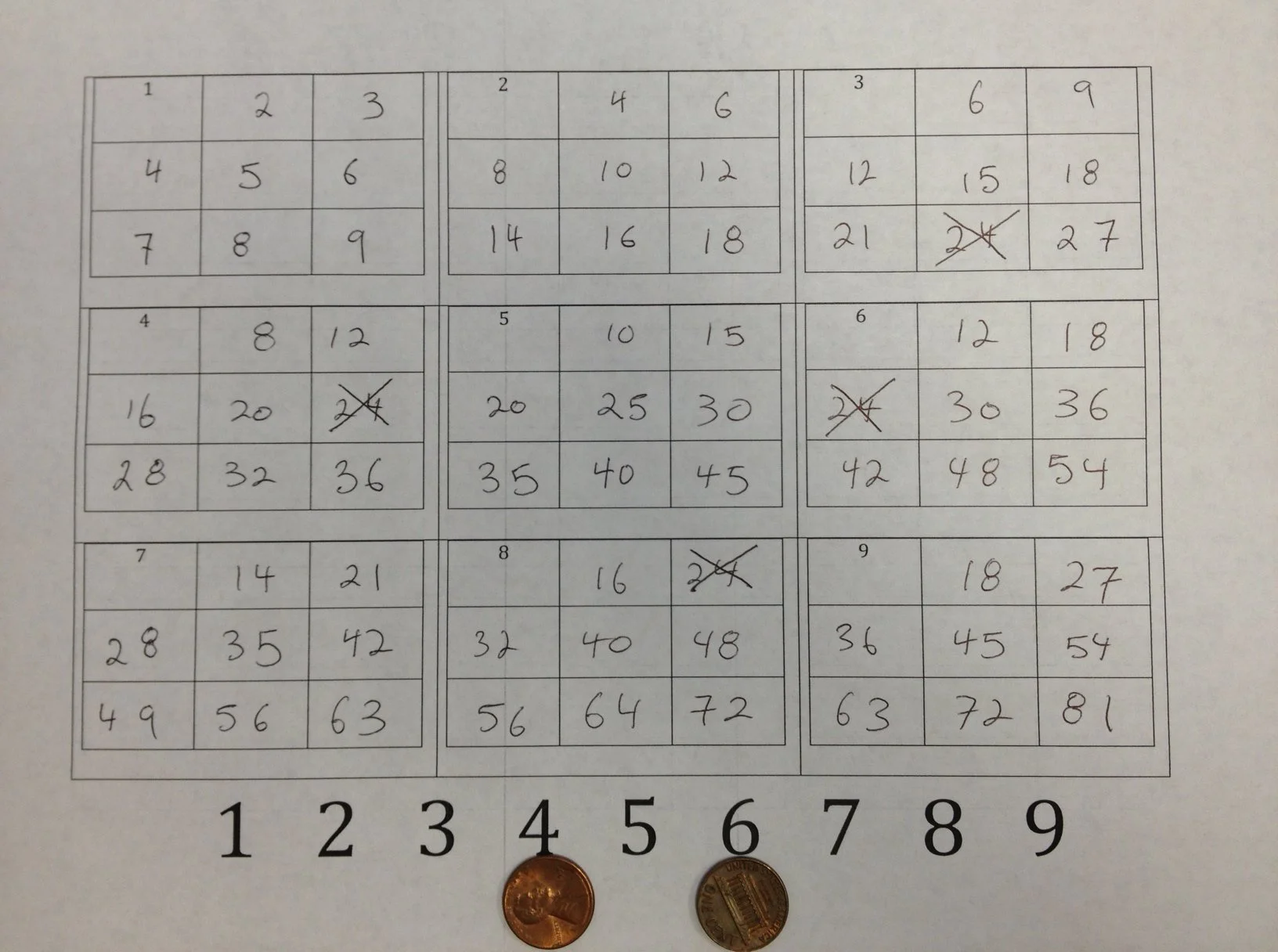
It started on a piece of paper.
In 2013 I was teaching third and fourth graders and I posted this as a pencil game on my old teacher blog. Paper, a pencil, and two pennies. Everything in the box today grew out of that.
Why it earns a slot in your week
When playing MULTI, the multiplication table isn't a chart to memorize, it's a map to navigate. Your kids will hunt for structure because the structure is how you win:
K-2: arrays, area, square numbers, symmetry, pattern recognition
Grades 3-5: everything above, plus multiples, common multiples, factors, and common factors
Middle school and up: everything above, plus combinatorics, game theory, and "could I code a bot to play this?"
Same box. One table. That's the part that matters when you're teaching three ages at once.
Your first week
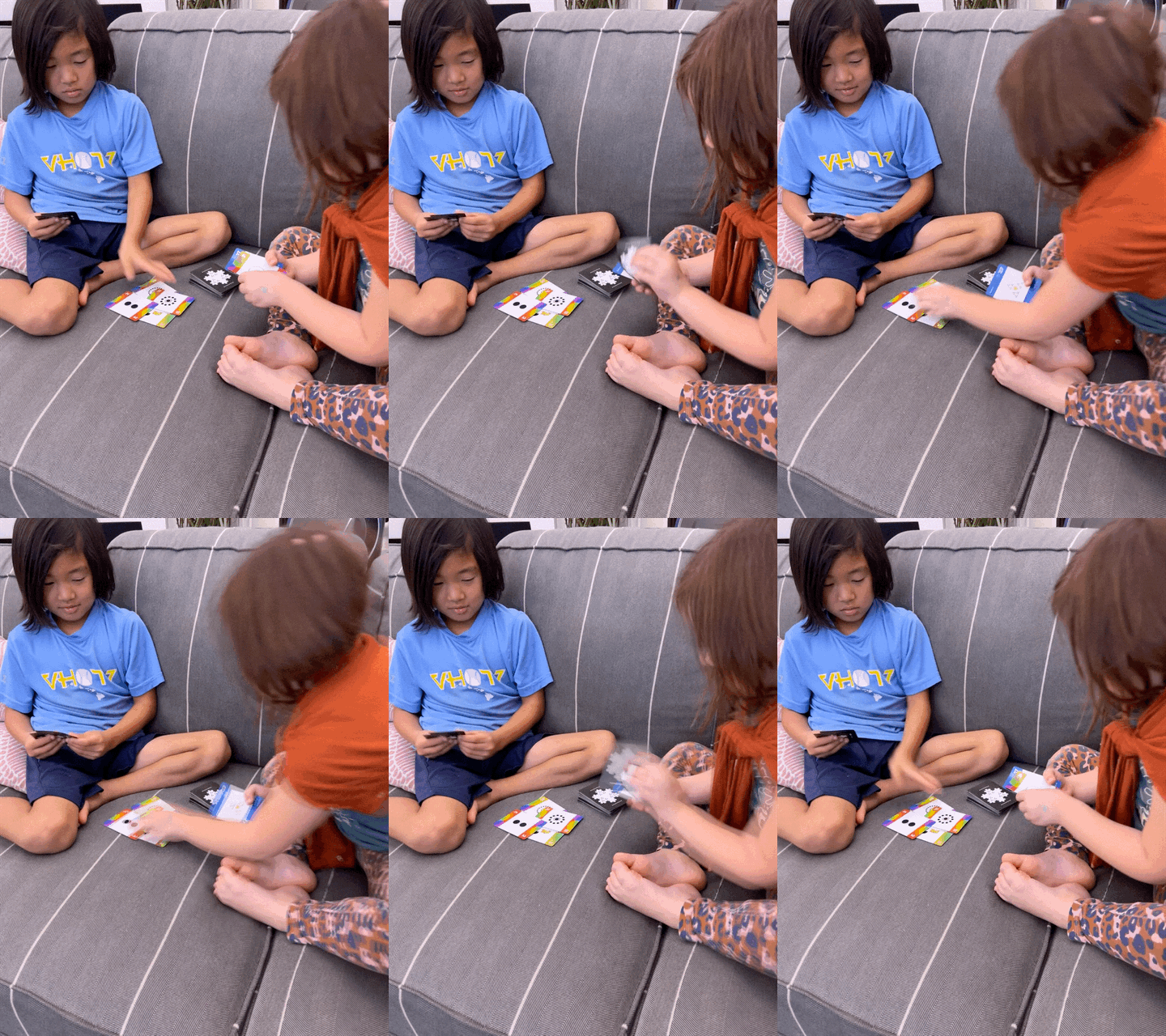
Day 1: Just play. No questions, no goals. It is completely fine to play MULTI purely for fun and the joy of the game. With MULTI, they're doing mathematics either way.
Day 2: Start with one question. Something accessible and tied to a winning strategy. For example:
Which numbers come up the most, meaning which products let you place the most Xs or Os in a single turn?
Then get out of the way. If they wander into symmetry, or squares, or best openings, go there. The question is a door, not a destination.
If it doesn't land, break it smaller. Which numbers show up more than twice? Can you find one that's only in a single spot?
If it lands right away, go harder. Why can't a number show up five times?
Either way, stop there. A game interrupted every two minutes stops being a game. The idea is to have so much fun, that you’ll want to play again! Let ideas percolate. Play the long game.
(For your back pocket: 6, 8, 12, 18, and 24 each show up four times. Only five numbers show up exactly once: 1, 25, 49, 64, and 81. Notice that every one of those is a square number. Ask them why that has to be true. That answer, and a few dozen more questions like it, are in the Home Guide.)
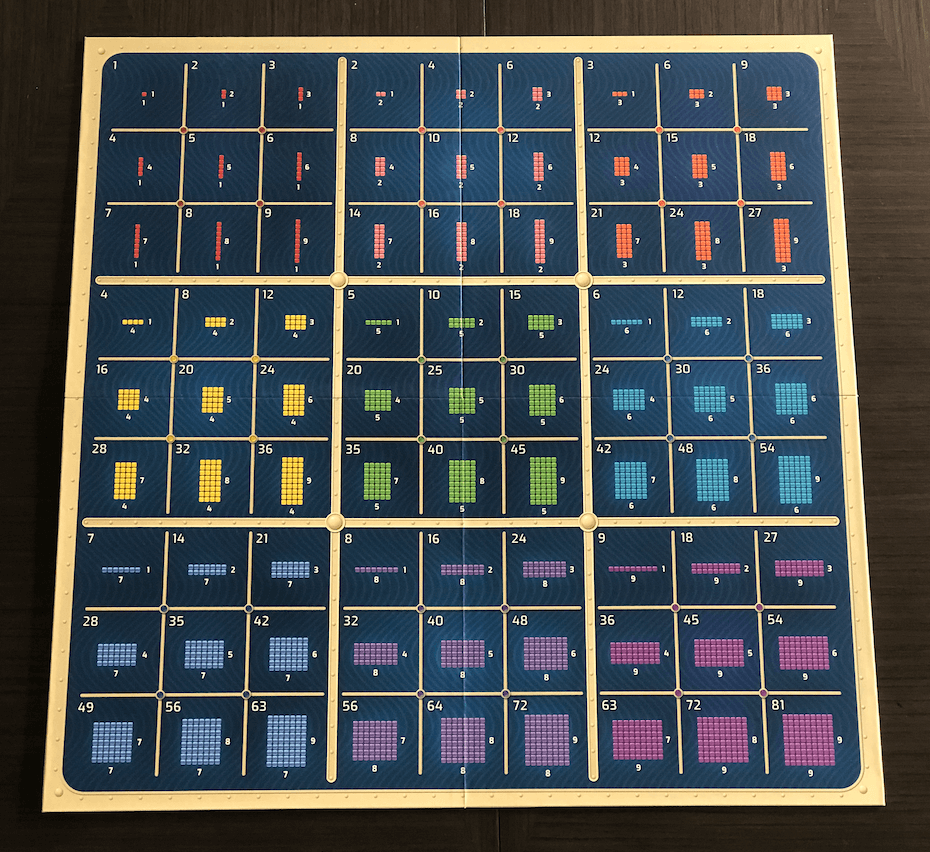
Day 3: Build the board on paper. Here is the blank grid I have been handing out since 2013. Nine empty mini boards. Have them fill each one in: the 1s board gets 1 through 9, the 2s board gets 2 through 18, the 7s board gets 7 through 63, and so on. Filling it in means computing an entire 9×9 multiplication table, each row filling its own 3×3 square.
One of the first years I did this with my third and fourth graders, I mentioned in passing that you could analyze the board by how many spots each number claims. A few days later I was walking down the hallway and found a board on the floor next to the cubbies. A student had started color-coding it on her own. Nobody assigned that, it was driven by her own curiosity.
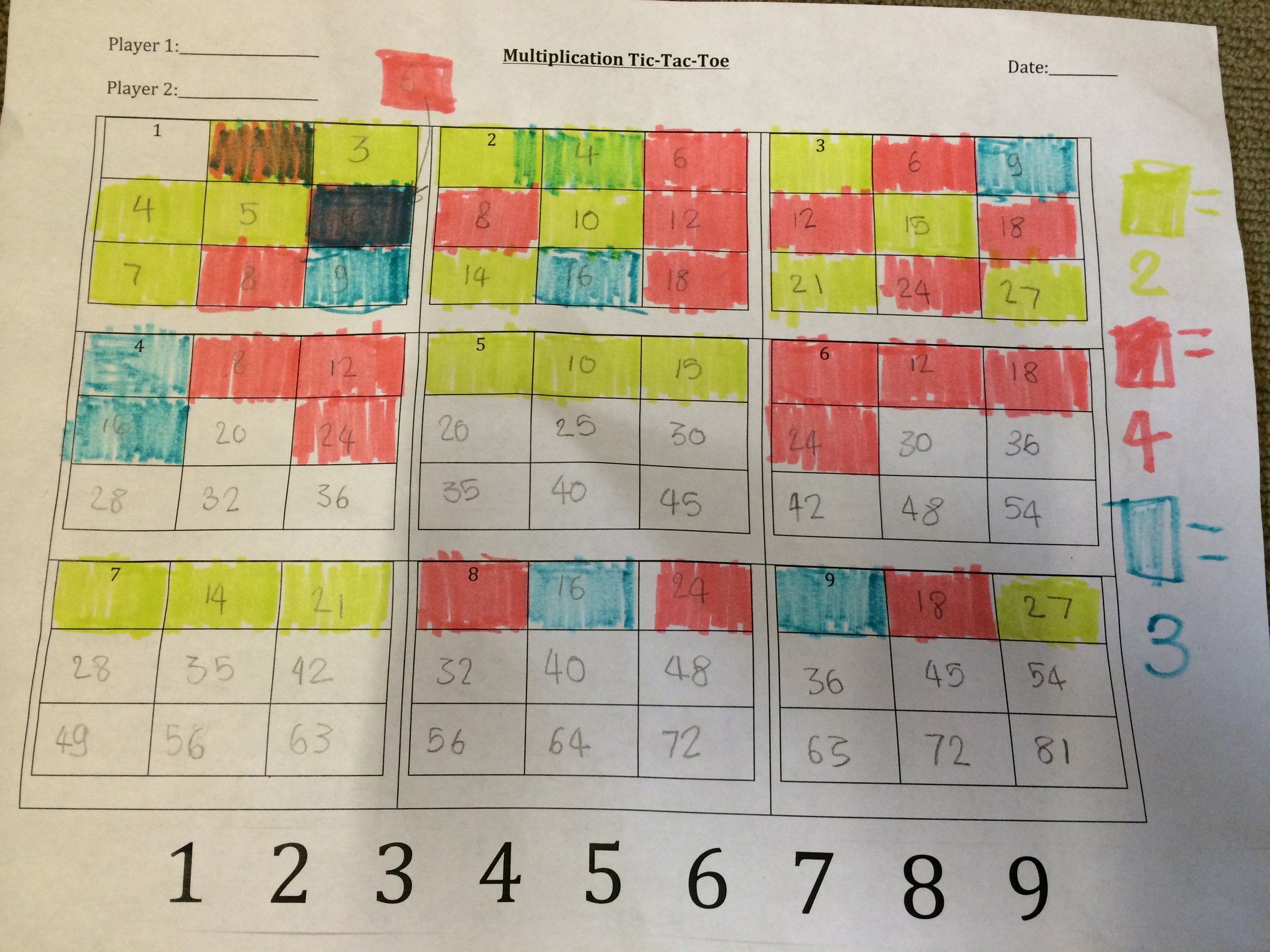
Since then I like to have students do the same, color-code the table. One color for products that appear four times across the whole grid, another for three, two, one. Color-coding makes the structure jump out visually. Here is the color-coded version if you want to check their work, though I would let them check each other's work first.
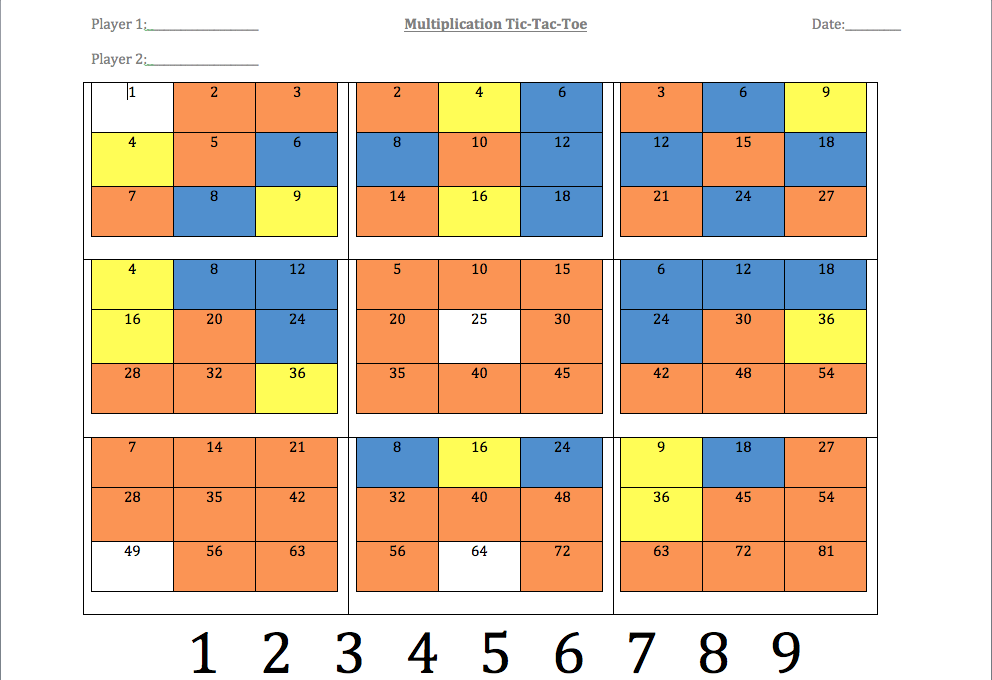
Color-coding makes the structure jump out visually.
The full rules for the paper version can be foud in the original 2013 post.* Paper, pencil, two pennies, and you're playing.
*A few things have changed since 2013. The Print and Play and tabletop editions have the current rules.
Building the board once is a great lesson. Building it every Tuesday is a chore, which is why the printed version exists, with arrays instead of bare numerals and our print and play version also comes with a factorization diagram version.
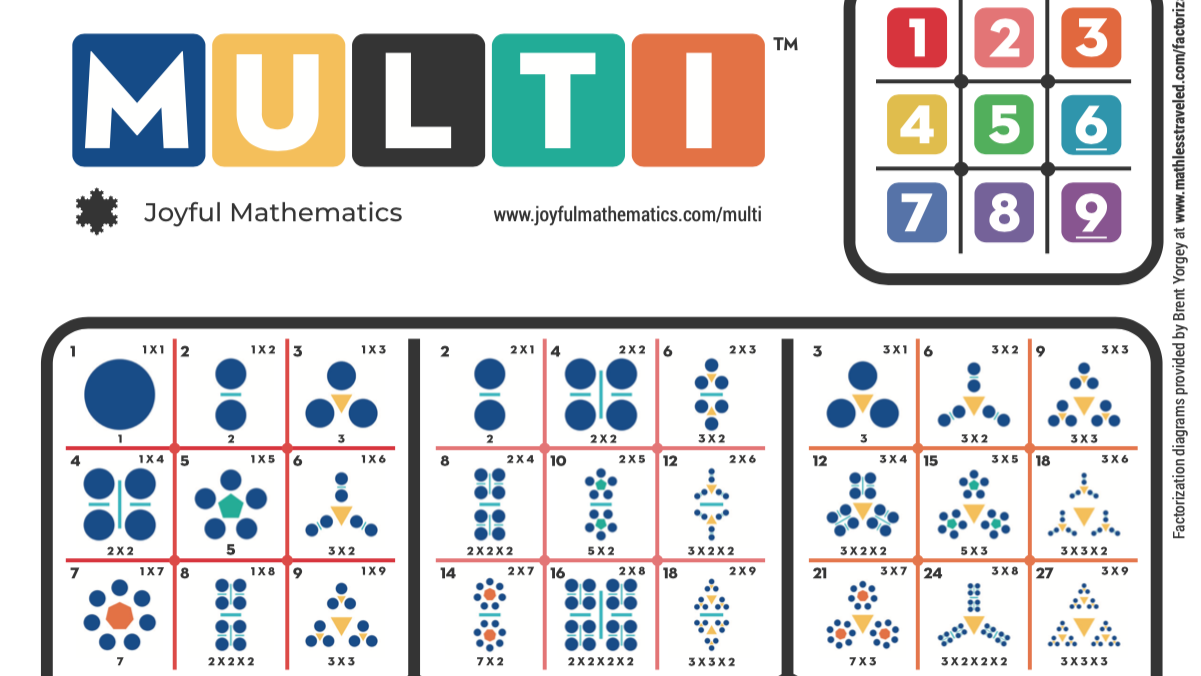
Day 4: Talk strategy. Ask why landing on a square number often guarantees you another move on that same mini board. Both tokens are allowed to sit on the same factor, so play 36 as 6×6 and your opponent can only pull one of them off. Then ask when it fails: 36 is also 9×4, and played that way the guarantee vanishes.
Day 5: Notice and Wonder. Take some time to explore what is noticed and wondered about the game. For younger kids, you can keep it countable and verifiable:
How many different ways can you make 12 on this board?
Which number has the most ways?
How many square numbers are there, and which ones have more than one way to claim them?
For older kids, the same instinct scales:
How many different games are possible?
Could you write a program to play the game at different levels of skill?
Questions like these can open into number theory, combinatorics, game theory, and computer science, the kind of question a curious kid keeps working on long after the week ends.
If you'd like us to dedicate a future blog to exploring one of these topics in depth, leave a comment or drop us a note.
Still unsolved
In a follow-up post in 2013 I wrote that one of these days I would like to work out the optimal strategy for this game, and I asked anyone who figured it out to let me know.
Thirteen years later I still don't have an answer, and as far as I know nobody has published one. Is there a first-move advantage? Is there a forced win? Does the wildcard rule change anything? If your kid wants a real open problem instead of a worksheet, this is one. Send us what you find.
The part that matters on a random homeschool morning
Your kids can play MULTI without you.
Simple rules and a game structure create space for children to explore independent of adults. No need for a referee, nor to be asking "is this right?" every ninety seconds. Just play. Opponents are extremely motivated to doublecheck arithmetic. One game equals twenty minutes of real math for two of them while you sit 1:1 with the third.
Odd number of kids, or a big age gap? Play in teams. Pair the 6-year-old with the 11-year-old and the gap stops mattering, because the older one has to say the reasoning out loud to a partner. That narration is the lesson.
And when you do run it yourself, give each kid a different question. Ask one to hunt square numbers, one to block an opponent by refusing to park on the factors they need. That's three different lessons on the same board, and nobody is doing a worksheet.
Go deeper
The full MULTI Home Guide: every discussion question, board patterns with images, strategy talk, endgame puzzles, and challenge questions
MULTI Lesson Plan: structured version for co-ops and group settings
Fraction Talks: our favorite routine for visual, creative fraction work
Get MULTI
Three ways in, depending on what you need:
Free: the blank grid and the color-coded board from 2013. Paper, pencil, two pennies.
Print and Play Edition: print it, cut it, play this afternoon. Includes the factorization diagram version.
The printed game: our shop or Amazon. Arrays instead of numerals, color coding built in, factorization diagrams, and nothing to prepare.
Let joy be your guide, and the math will follow.
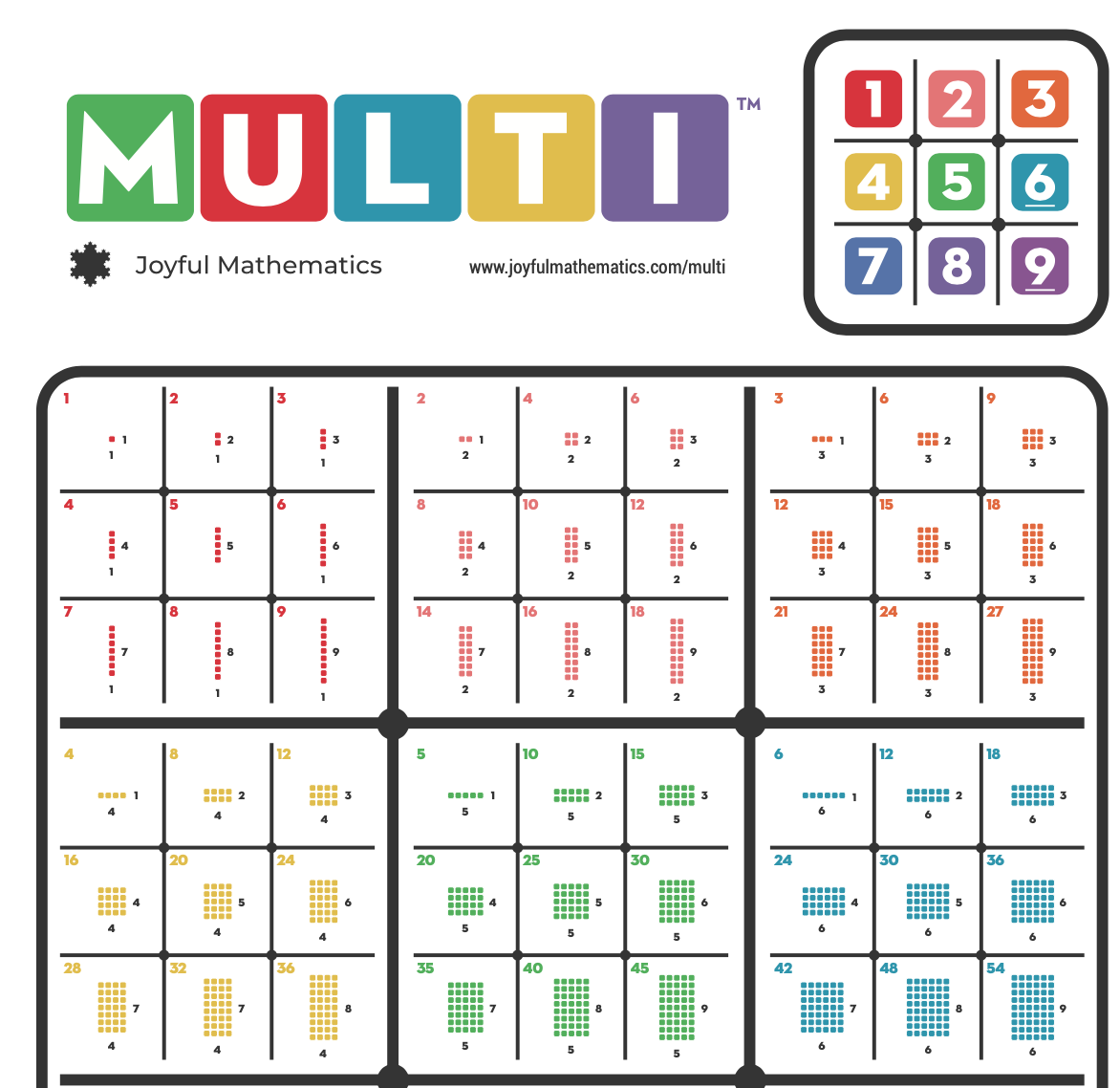
We’ve updated the original file to include a second option for how the multiples are represented on the MULTI board, factorization diagrams! Two MULTI boards for the price of one!
The MULTI print and play version is a great option if you want to play the game right away. MULTI PNP Edition is ideally played by laminating the board and using whiteboard markers, this makes for a reusable, durable and ultra-portable version of the game.
Many have also used the PNP version to play remotely using google slides or jamboards.
Whether you want to make a class set, play at home, or take the game on the go, MULTI PNP has got you covered!

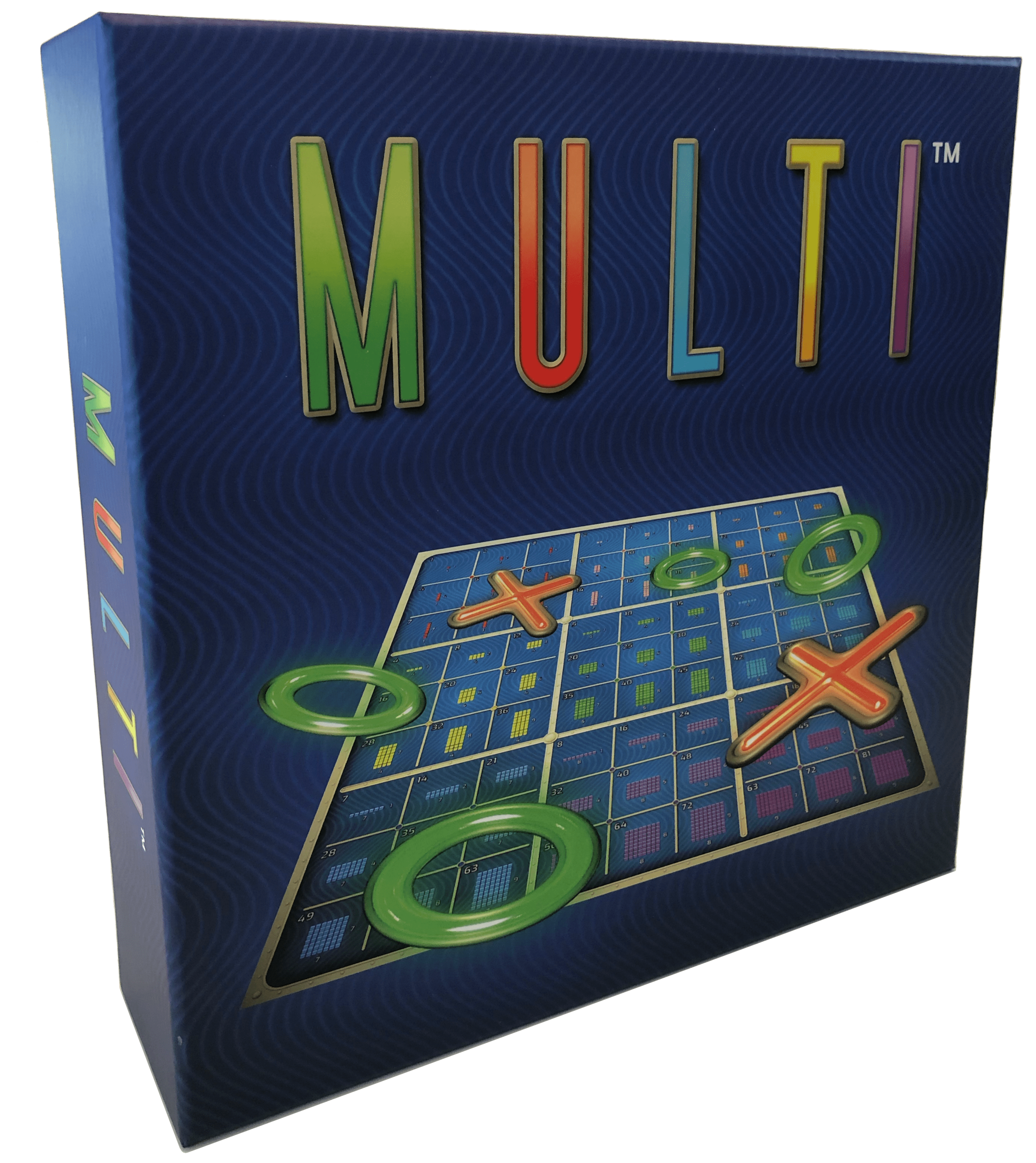
Multiply your fun with MULTI, where everything is multiplied!
A beautiful combination of mathematical structure and tic tac toe tactics leading to a fantastic 2-player game experience for all ages!
Multiple boards, multiple sizes, even play with multiple Xs and Os on the same turn as you play on 10 tic tac toe boards simultaneously!
Learn about and apply the structure and symmetry of numbers, multiples, and factors through play!
Please contact us for shipping options to countries not listed as an option, or for discounts on bulk orders.