

How to Use this Lesson
Updated August 2026
This is meant as a general outline for how to structure a lesson around MULTI. Whether your students are in early elementary, upper elementary, middle school or above, this structure will work to help groups of students pull out the many mathematical concepts connected to playing MULTI.
Instead of writing a lesson for each grade band such as K-2, another for 3-5, and another for middle school and beyond, I will describe the mathematics each grade band could potentially get into and leave it to the teacher to decide what concepts to guide their students through.
Overview
Session 1 — Learning to Play (45–60 minutes)
Notice/Wonder → Game Reveal → Play Time → Sharing Strategies → Exit Ticket. This lesson serves as a one-time onboarding and includes an introduction to the board, how to play the game, and a way of talking about strategy that draws out mathematical structures and patterns.
Sessions 2 and Beyond (20–25 minutes each)
Boards out (2 min) → play (15–20 min) → one strategy question (3 min). No prep, no re-teaching. Students who missed Session 1 can be taught by a partner in about two minutes.
Games speed up as students become familiar with the board, the rules, and as recall gets easier. The first few run fifteen to twenty minutes, then closer to ten; some students may fit two games in a session.
Spread across weeks — 20 minutes at a time
I playtested MULTI in my own classroom for ten years before it became a board game, and the thing that surprised me was how well it held up on the tenth play. Students came back with strategies they'd been working out in between. That's why I'd recommend a twenty-minute session — say, every Friday — for four weeks over one long block. The spacing is doing real work here, both for engagement and for moving what they learn into long-term memory.
Key Topics
Early Elementary (K-2)
Arrays, rectangles, area, square units, etc.
Square Numbers
Recognizing patterns and structure
Symmetry
Strategy in general, and/or for openings and endgame situations
Upper Elementary (3-5)
Arrays, rectangles, area, square units, etc.
Square Numbers
Recognizing patterns and structure
Symmetry
Strategy in general, and/or for openings and endgame situations
Multiples, common multiples
Factors, common factors
Middle School and Beyond
Arrays, rectangles, area, square units, etc.
Recognizing patterns and structure
Symmetry
Strategy in general, and/or for openings and endgame situations
Multiples, common multiples
Factors, common factors
Square Numbers
Combinatorics
Game Theory
Computer Science, coding, machine learning, etc.
Session 1: Learning to Play — The Lesson Plan
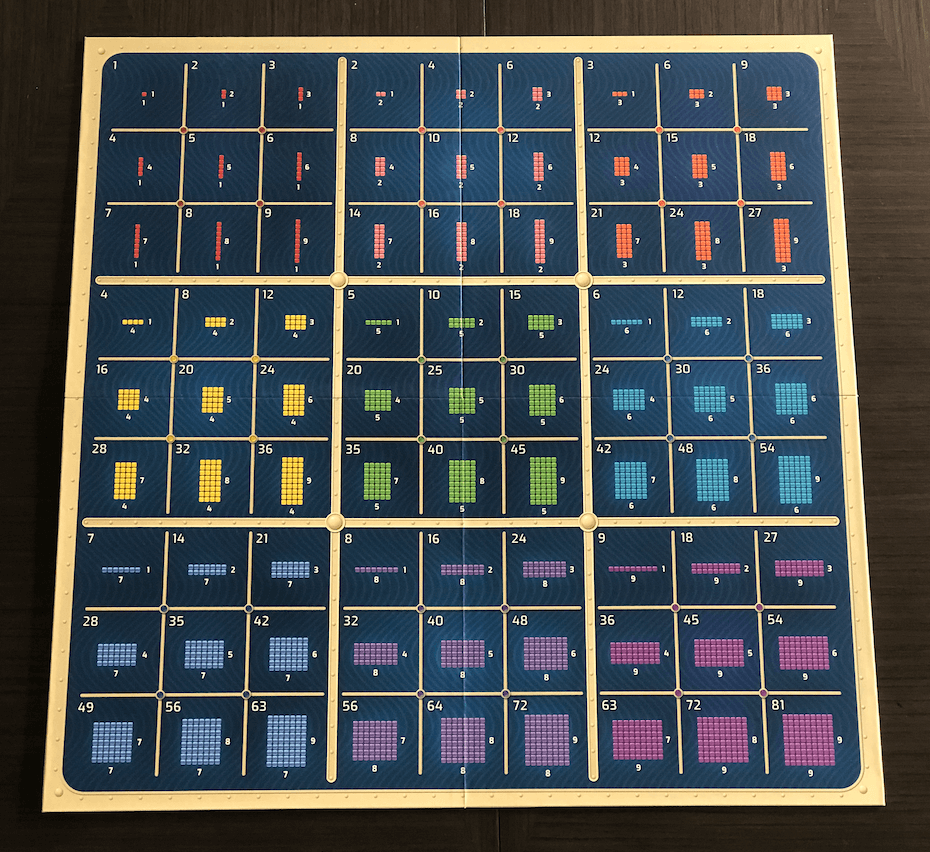
What do you notice?
What do you wonder?
Notice/Wonder (5-10 minutes)
Display the Factor Board, MULTI board, or both to your students. (Depending on your setting, you could also have each student holding a print and play board or pairs of students in front of each board.)
Ask “What do you notice?” and “What do you wonder?”
Consider using a “Think, Pair, Share” model to help generate and record a greater number of student observations.
Record Notice and Wonder on the board, document, or chart paper.

Review the Rules
Teacher-led or in small groups/partners
The Game Reveal (5-10 minutes)
“This is a game called MULTI, here are the rules…”
This could be teacher-led guided reading using a slideshow, or you could just hand out the rules and let them figure it out, or somewhere in between.
Play Time (15-25 minutes)
Give students enough time to finish a game; most first games run fifteen to twenty-five minutes. If students finish earlier than others, have them play again.
Once every pair has completed a game, you can ask everyone to pause and take a moment to think about what they noticed/wonder about the game now and/or what strategies did they and their partner use?

Strategy Talk
What’s the best strategy here? How do you know?
Sharing Strategies (10-15 minutes)
If possible, have students switch partners and share the strategies they used.
Next, have students share out their strategies with the whole group.
Record their strategies on the board, document or chart paper.
Exit Ticket (5 minutes)
There are lots of possible exit tickets depending on the topics discussed in the lesson. Here are a few examples...
Describe a pattern you noticed on the MULTI board.
Where on the board do you find the multiples of 5? What about the multiples of 9?
What number comes up the most?
What numbers come up the least?
What’s a good opening move?
Describe your strategy.
Describe the strategy your opponent used against you.
Show students an endgame situation and ask them to describe what they would do and why?
Show students a game situation and ask them to decide who they think will win and why?
How many different possible games are there?
Sessions 2 and Beyond (20-25 minutes each)
Boards out (2 min) → play (15–20 min) → one strategy question (3 min).
These sessions assume most of your students learned the game in Session 1. A student who was absent can be taught by a partner in about two minutes, so you rarely need to re-teach anything to the whole room.
Setting Up With What You Have
One copy. Play the class against the teacher. Students propose moves, argue for them, and vote; you play for the other side. This is the version I'd recommend even to teachers who own several copies, because every move has to be justified out loud; you hear the reasoning that partner play keeps private. It's also the fastest way to run a focused session, since you control the pace and can pause on any position worth discussing.
A few copies. Set up a MULTI station and rotate pairs through it during independent work or centers. Four or five sessions and everyone has played. Pairs who've played before can onboard the ones who haven't, which frees you up entirely.
A copy for every pair. Print and play is the cheap path here. Laminate the boards, or slide them into sheet protectors, and students play with dry-erase markers, wipe clean and they're ready for the next session. Some teachers and schools have opted to buy a class set of the tabletop edition, and have hosted round-robin or bracket style tournaments.
Focus Questions for Return Sessions
Each return session can carry a focus. Name it before students play, then use it for the closing question. A few that work:
Openings: Is there a best first move?
Multiples: Where do all the multiples of a given number live on the board?
Squares: Where do the squares live on the board? How can you play square numbers?
Blocking: What are the ways to stop an opponent from claiming a number they need?
If you have any questions about how to weave specific topics into a lesson or how to adapt the lesson to your setting, don’t hesitate to contact us.
Where can I get a copy of MULTI?
You can purchase the digital print and play version and table top edition in the Joyful Mathematics Shop, the table top edition is also available on Amazon.
